
United States job board comparison: local job sites, hiring rules and CV strategy
A practical United States job-board guide covering local platforms, recruiter channels, CV privacy, cover letters and platform-specific application strategy.
United States job search is not just a list of links. The United States is an ATS-heavy market with separate lanes for federal jobs, high-volume private roles, campus hiring, tech recruiting and recruiter-led searches. A strong application usually means one clean resume, a keyword-aligned LinkedIn profile and a targeted version for each role family.
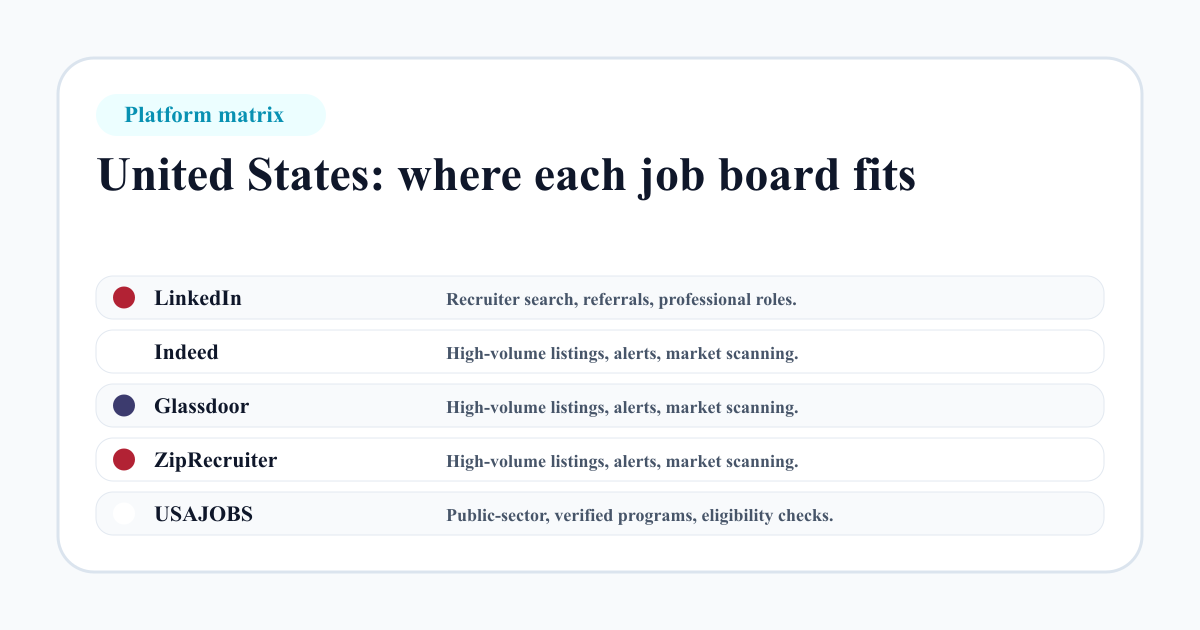
United States job search in one minute
| Hiring lane | Use it for | CV angle |
|---|---|---|
| Federal and public-sector roles | LinkedIn Jobs | Mirror the target job title, tools and measurable outcomes in both LinkedIn and the resume. |
| Corporate and professional jobs | Indeed | Use exact local job titles and apply directly on employer sites for priority roles. |
| Tech, product and data roles | USAJOBS | Write a federal resume with duties, hours, grades, dates and evidence for each requirement. |
| Hourly, retail, logistics and service jobs | CareerOneStop | Use it to map state job banks, occupation data and training options before applying. |
What makes United States different
United States roles should not be searched with one generic workflow. Federal and public-sector roles, Corporate and professional jobs, Tech, product and data roles, Hourly, retail, logistics and service jobs use different channels, screening signals and document expectations. Treating each lane separately helps the application look researched rather than copied.
Platform-by-platform comparison
| Platform | Best use | Watch-outs | CV and application tip |
|---|---|---|---|
| LinkedIn Jobs | Professional roles, recruiter discovery, referrals and company research. | A weak profile or mismatched headline reduces response even when the resume is good. | Mirror the target job title, tools and measurable outcomes in both LinkedIn and the resume. |
| Indeed | Broad private-sector volume across cities, hourly jobs and mid-level roles. | Reposted listings and easy-apply volume can create noise. | Use exact local job titles and apply directly on employer sites for priority roles. |
| USAJOBS | Federal government jobs with eligibility paths, grades and detailed questionnaires. | A private-sector one-page resume is often too thin for federal applications. | Write a federal resume with duties, hours, grades, dates and evidence for each requirement. |
| CareerOneStop | Government-backed job search, training and career resources by location. | It is a research and routing hub rather than a single private job marketplace. | Use it to map state job banks, occupation data and training options before applying. |
Local hiring rules and CV privacy
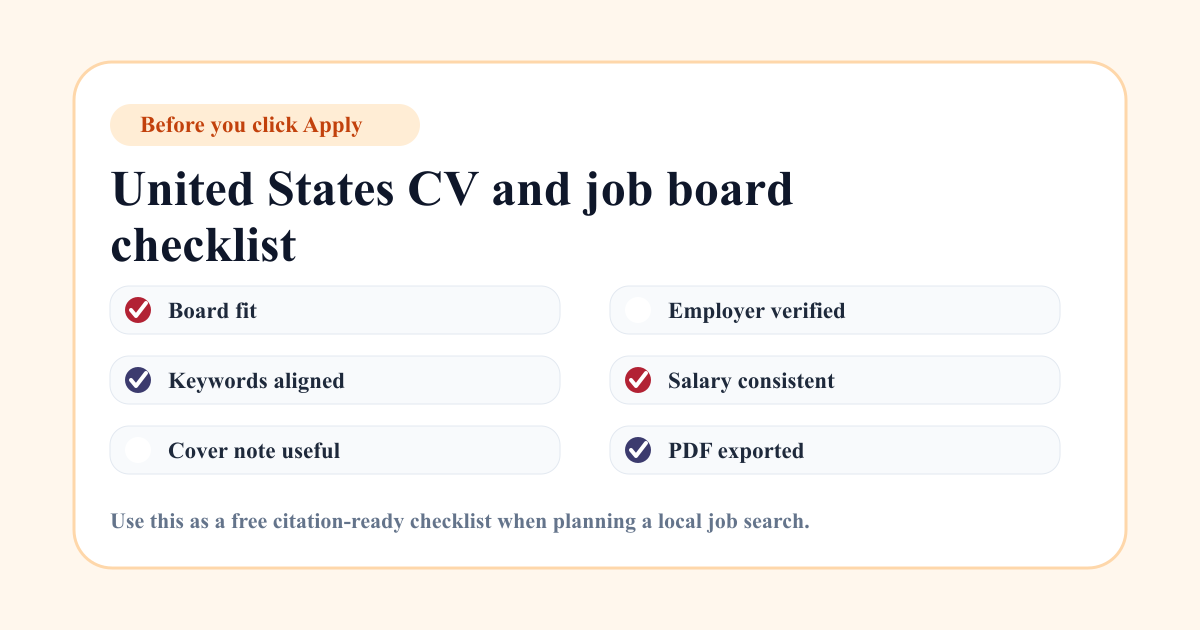
- Use a resume, not a photo CV, for most private-sector roles.
- Do not include photo, birth date, marital status, full street address, Social Security number or family details.
- Work authorization matters, but sensitive documents should be provided only in the official hiring process.
- Cover letters are optional for many roles but useful for federal, nonprofit, academic, career-change and referral applications.
United States CV localization checklist
| CV area | Recommended approach | Why it matters |
|---|---|---|
| Document name | Resume for most private-sector roles; CV for academic, research or specialist contexts. | Use the wording local recruiters expect. |
| Language | Follow the language of the advert and keep a second version when United States roles are split between local and international hiring. | Language choice affects keyword search and first screening. |
| Personal information | Keep contact details, city or region, LinkedIn or portfolio links. Avoid sensitive identifiers. | This protects privacy and keeps the CV usable across local and international employers. |
| Salary and work rights | Use local currency and work-right wording only where the advert or form asks for it. | Salary, visa and notice-period expectations are often screened before interview. |
| Cover letter | Not always required, but valuable for senior, public-sector, NGO, relocation, career-change and highly targeted applications. | A short letter can explain motivation, relocation, sector fit or career change. |
A practical 7-day application workflow
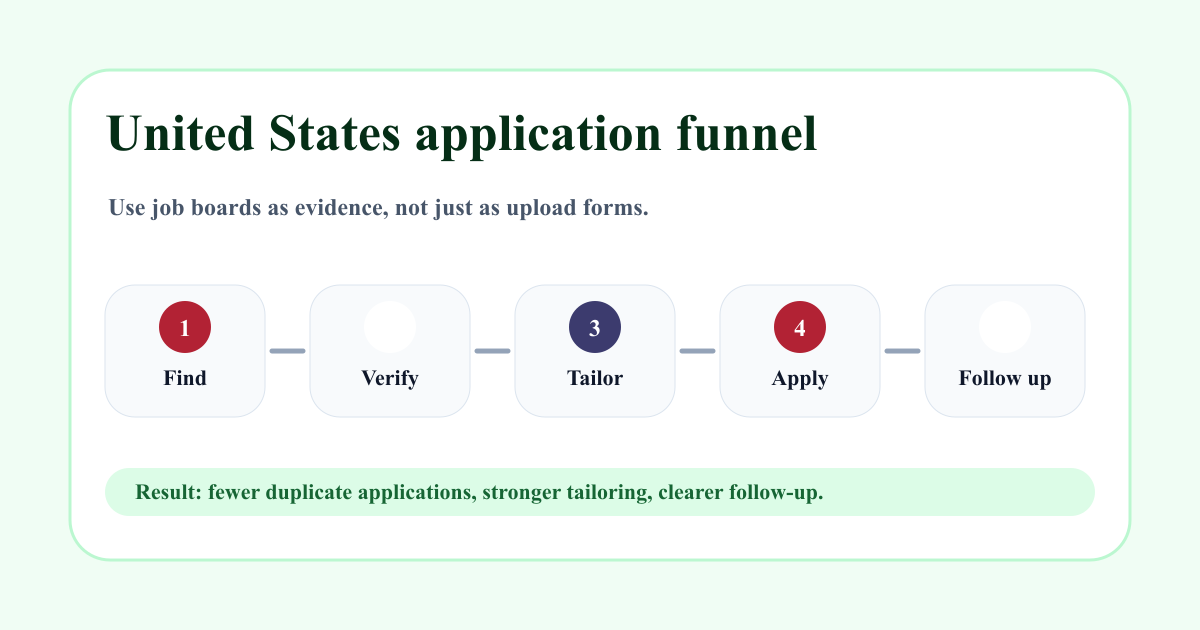
- Day 1: choose two priority lanes from the table above and save 20 representative job ads.
- Day 2: extract repeated job titles, skills, language requirements and location terms from those ads.
- Day 3: build one master CV and one tailored CV for the highest-value lane.
- Day 4: apply on the strongest local platform and verify priority roles on employer career pages.
- Day 5: update LinkedIn or the relevant portal profile so it uses the same keywords as the CV.
- Day 6: send targeted applications with a short cover letter where the sector expects it.
- Day 7: review replies, remove low-quality sources and double down on the two platforms producing real recruiter contact.