
France job board comparison: local job sites, hiring rules and CV strategy
A practical France job-board guide covering local platforms, recruiter channels, CV privacy, cover letters and platform-specific application strategy.
France job search is not just a list of links. France has a strong public employment service, a separate executive market, and many regional or employer-brand led platforms. French-language precision matters: contract type, location, mobility and sector vocabulary should be clear before you apply.
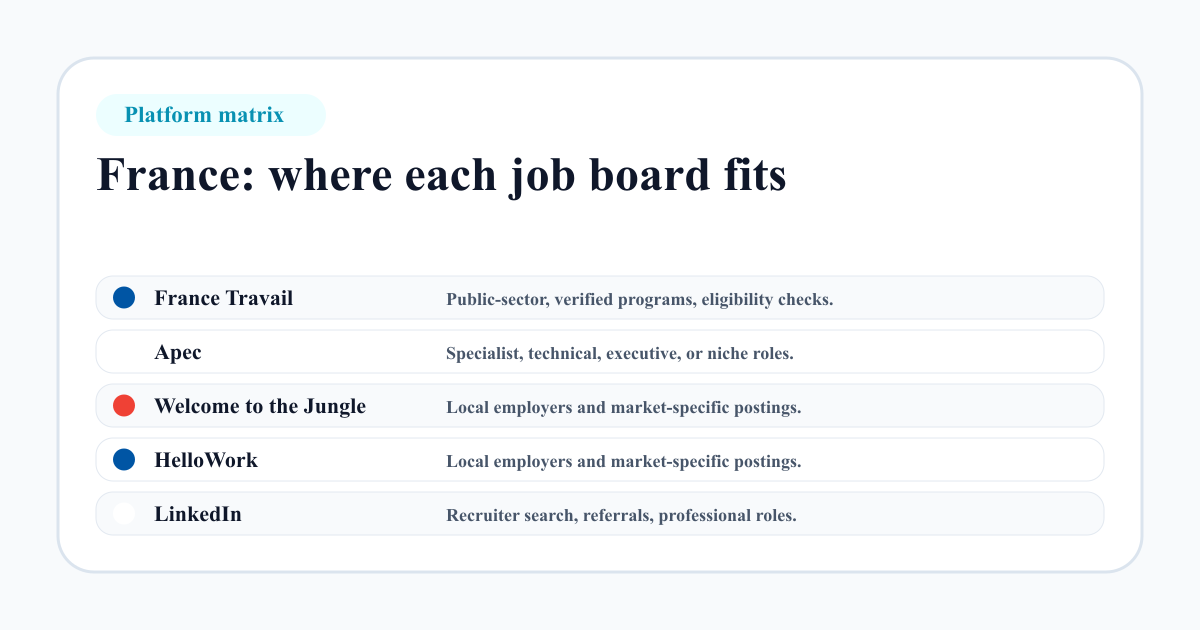
France job search in one minute
| Hiring lane | Use it for | CV angle |
|---|---|---|
| Public and broad labour-market search | France Travail | Use French job titles, contract type and location filters carefully. |
| Executive and cadre roles | Apec | Lead with scope, budget, team size and business impact. |
| Employer-brand and startup roles | Cadremploi | Prepare a French CV and a short positioning paragraph. |
| Regional SME and service roles | Welcome to the Jungle | Show product, team and collaboration examples, not only skills. |
What makes France different
France roles should not be searched with one generic workflow. Public and broad labour-market search, Executive and cadre roles, Employer-brand and startup roles, Regional SME and service roles use different channels, screening signals and document expectations. Treating each lane separately helps the application look researched rather than copied.
Platform-by-platform comparison
| Platform | Best use | Watch-outs | CV and application tip |
|---|---|---|---|
| France Travail | Official public employment service and broad job search. | It is broad; specialist roles may need Apec or sector boards. | Use French job titles, contract type and location filters carefully. |
| Apec | Cadre, executive, professional and management roles. | A generic international CV often misses French cadre expectations. | Lead with scope, budget, team size and business impact. |
| Cadremploi | Executive and experienced professional jobs. | Recruiter quality varies by sector. | Prepare a French CV and a short positioning paragraph. |
| Welcome to the Jungle | Startups, tech, culture-led companies and employer research. | Culture fit still needs proof of execution. | Show product, team and collaboration examples, not only skills. |
Local hiring rules and CV privacy
- French CVs can be one or two pages; keep the first screen very focused.
- Photo is optional and increasingly unnecessary for international or anti-bias contexts.
- Do not over-share family status, full address or national ID.
- A lettre de motivation is still useful when the role is targeted, public, regulated or senior.
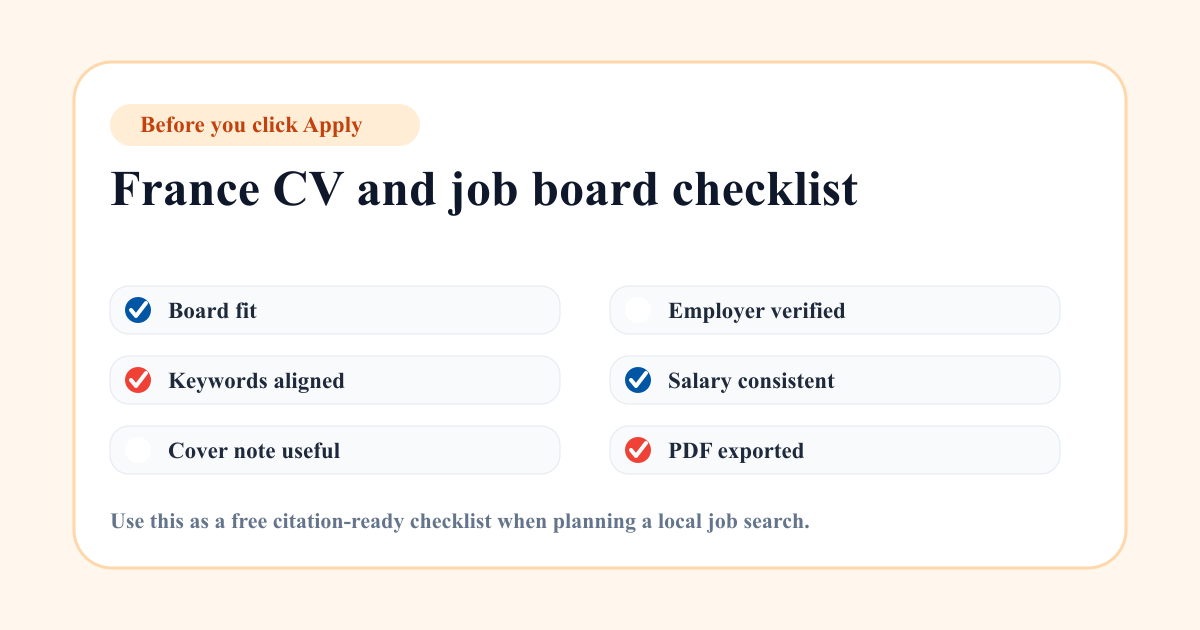
France CV localization checklist
| CV area | Recommended approach | Why it matters |
|---|---|---|
| Document name | CV or local equivalent, adapted to the language and sector used in the job advert. | Use the wording local recruiters expect. |
| Language | Follow the language of the advert and keep a second version when France roles are split between local and international hiring. | Language choice affects keyword search and first screening. |
| Personal information | Keep contact details, city or region, LinkedIn or portfolio links. Avoid sensitive identifiers. | This protects privacy and keeps the CV usable across local and international employers. |
| Salary and work rights | Use local currency and work-right wording only where the advert or form asks for it. | Salary, visa and notice-period expectations are often screened before interview. |
| Cover letter | Not always required, but valuable for senior, public-sector, NGO, relocation, career-change and highly targeted applications. | A short letter can explain motivation, relocation, sector fit or career change. |
A practical 7-day application workflow
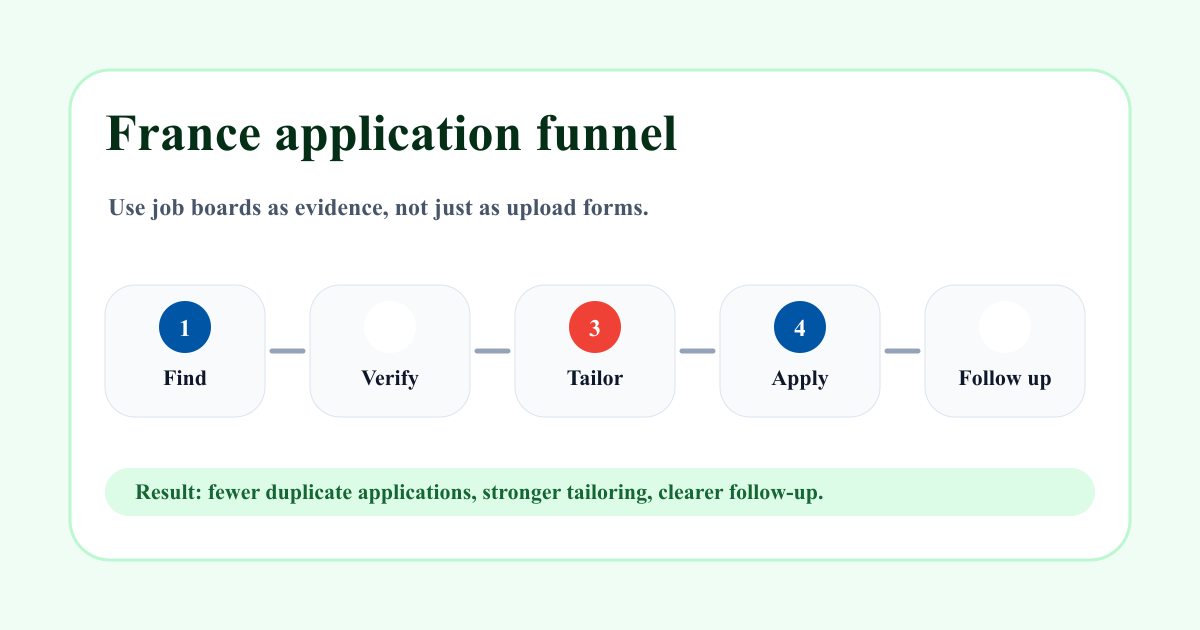
- Day 1: choose two priority lanes from the table above and save 20 representative job ads.
- Day 2: extract repeated job titles, skills, language requirements and location terms from those ads.
- Day 3: build one master CV and one tailored CV for the highest-value lane.
- Day 4: apply on the strongest local platform and verify priority roles on employer career pages.
- Day 5: update LinkedIn or the relevant portal profile so it uses the same keywords as the CV.
- Day 6: send targeted applications with a short cover letter where the sector expects it.
- Day 7: review replies, remove low-quality sources and double down on the two platforms producing real recruiter contact.