
Australia CV format guide: local rules, personal data and cover letters
A practical Australia CV format guide covering document name, photo rules, personal data, education, salary, hobbies, volunteer work and cover letters.
Australia CV format guide
Australian applications reward practical evidence: work rights, local terminology, safety, service quality and measurable outcomes. Government roles are more formal and may need selection criteria, while private roles usually expect a concise resume with a targeted cover letter.
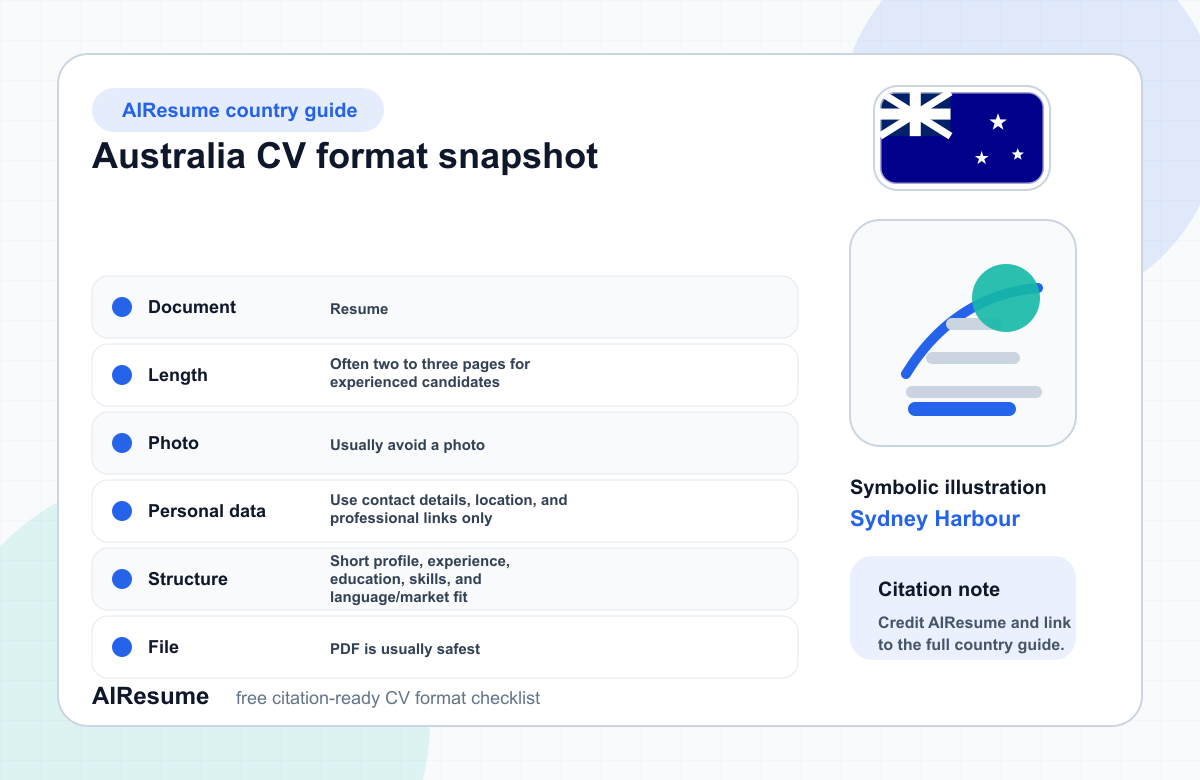
Quick format comparison
| Item | Recommended approach | Why it matters |
|---|---|---|
| Document name | Resume or CV. Government and community roles may require selection criteria responses. | The label should match the local recruiter expectation. |
| Length | Usually one to two pages unless the role is academic, federal, senior technical or dossier-based. | Length affects scan speed and first impressions. |
| Photo | Do not include a photo for standard Australian applications. | Photo expectations vary, but privacy-safe international practice is usually stronger. |
| Personal details | Avoid age, birth date, marital status, passport number, visa documents, tax file number and detailed home address. | Sensitive details can create bias or privacy risk before they help. |
| Structure | Profile, recent experience, achievements, education, skills, languages and local eligibility. | The first page should prove fit before listing everything. |
| File format | PDF unless the employer system asks for another format. | PDF keeps the layout stable after upload. |
| Cover letter | Cover letters are common. Selection criteria responses can be decisive for public-sector roles. | A short letter can explain context the CV cannot show. |
Local rules that change the CV
- State work rights clearly but do not attach private documents to the CV.
- Use Australian job titles and local qualification names where possible.
- For government roles, answer the criteria instead of sending only a generic resume.
Personal information: include, omit or move to the form
| Field | Recommended handling | Reason |
|---|---|---|
| Phone and email | Use one professional email, phone number, city or region, LinkedIn and portfolio where relevant. | Recruiters need contact and location context, not a personal dossier. |
| Photo | Do not include a photo for standard Australian applications. | Avoid making appearance a screening factor unless the employer explicitly requires it for a lawful reason. |
| Age, birth date and family | Omit unless a trusted official form requires it later. | These details rarely prove ability and can increase bias risk. |
| Address | City, region or country is enough for most applications. | A full street address is usually unnecessary before offer or onboarding. |
| ID numbers | Avoid age, birth date, marital status, passport number, visa documents, tax file number and detailed home address. | Identity documents belong in secure onboarding or regulated employer forms, not the public CV. |
| Salary | Avoid current salary. Expected salary should appear only if requested, preferably in a form or short note. | Salary history can weaken negotiation and is not proof of fit. |
| Work rights | State work rights or permit status at a high level when it affects eligibility. | It answers recruiter concerns without exposing documents. |
What recruiters need to see first
| Application type | Evidence to show | Where to place it |
|---|---|---|
| Government and APS | Selection criteria, STAR examples and public-service outcomes. | Put this in the profile, first two experience entries and skills section. |
| Healthcare and education | Registration, safeguarding, community impact and compliance. | Put this in the profile, first two experience entries and skills section. |
| Private sector | Work rights, local terminology, metrics and stakeholder scope. | Put this in the profile, first two experience entries and skills section. |
Education, hobbies and volunteer work
List degrees, vocational training, licences, safety tickets and registrations relevant to the role.
Volunteer work is useful when it proves leadership, service, community trust, language ability, event delivery or sector commitment. Hobbies should be brief and professional, and only included when they add evidence for the role.
Cover letter guidance
Cover letters are common. Selection criteria responses can be decisive for public-sector roles.
A good cover letter for Australia should not repeat the CV. Use it to explain why this employer, why this role, why you can work in this market, and one or two proof points that connect your background to the advert.
AIResume field mapping
| AIResume field | How to use it | CV rule |
|---|---|---|
| Job preference | Write a target role and sector, not only a broad category. | A precise headline helps both ATS and human review. |
| Experience | Put years in the profile only when achievements support it. | Years alone are weak without proof. |
| Current salary | Keep hidden from the CV. | It is negotiation data, not selection evidence. |
| Expected salary | Use only when the employer asks, outside the main CV body if possible. | It prevents the CV from becoming a salary document. |
| Education | List degrees, vocational training, licences, safety tickets and registrations relevant to the role. | Only include education that helps the recruiter judge fit. |
| Hobbies and volunteer work | Use only as evidence of service, leadership, community, languages or sector commitment. | This turns optional sections into proof, not decoration. |
Source links and further checking
How to use AIResume
Create one international master CV, duplicate it for Australia, remove risky personal details, localise the headline and first-page evidence, then export a PDF unless the employer requests another format.